Millard County Dog Registration Information
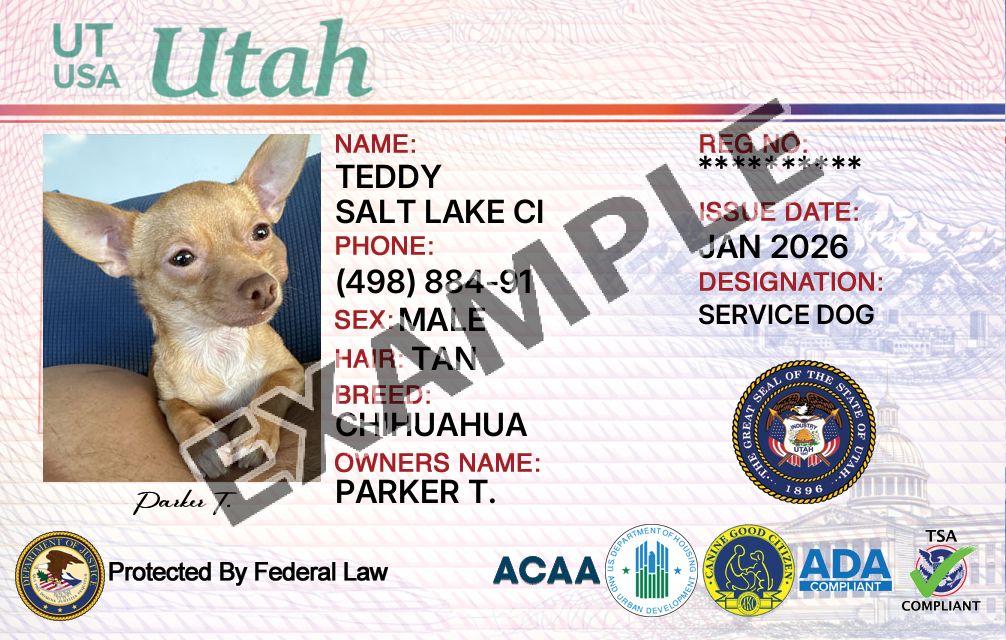
Service Dogs and Emotional Support Animals in Millard, Utah
If you’re asking where do I register my dog in Millard County, Utah for my service dog or emotional support dog, the most important thing to know is this: in most cases, you are really looking for a dog license in Millard County, Utah (a local licensing tag tied to rabies vaccination), not a “service dog registration” or “emotional support registration.”
Dog licensing and rabies enforcement are typically handled by local city offices (and sometimes the county sheriff/animal control functions), so the right place to start depends on whether you live inside a city (like Fillmore or Delta) or in an unincorporated part of the county. This page explains where to register a dog in Millard County, Utah, what paperwork is commonly required, and how licensing is different from service dog legal status and emotional support animal accommodations.
Where to Register or License Your Dog in Millard County, Utah
Because licensing is often handled at the city level, below are example official local offices within Millard County where residents commonly start when looking for an animal control dog license Millard County, Utah. If you live in an HOA, rural subdivision, or outside city limits, you may need to confirm whether your city office, the county, or another local authority handles licensing for your address.
Official Offices (Examples Within Millard County)
| Office | Address | Phone | Office Hours | |
|---|---|---|---|---|
| Fillmore City Office (Animal Control / Dog Licensing) |
75 West Center Street Fillmore, UT 84631 |
(435) 743-5233 | [email protected] |
Mon–Thu: 8:00 a.m.–5:30 p.m. Fri: 8:00 a.m.–12:00 p.m. |
| Delta City Office (Animal License / City Administration) |
76 N 200 W Delta, UT 84624 |
(435) 864-2759 | Not listed | Mon–Thu: 7:00 a.m.–6:00 p.m. |
| Millard County Sheriff’s Office (County Law Enforcement / Animal Control-related Issues) |
765 South Highway 99 Fillmore, UT 84631 |
435-743-5302 | Not listed | Not listed |
| Millard County Sheriff’s Office (Delta Office) |
71 S 200 W Delta, UT 84624 |
435-864-1400 | Not listed | Not listed |
| Central Utah Public Health Department (Fillmore Office) |
40 North 400 West Fillmore, UT |
(435) 743-5723 | Not listed (contact form referenced) | Mon–Thu: 7:30 a.m.–5:30 p.m. |
| Central Utah Public Health Department (Delta Office) |
362 West Main, Suite 1 Delta, UT |
(435) 864-3612 | Not listed | Mon–Thu: 7:30 a.m.–5:30 p.m. |
What “Registering” Usually Means Here
In Millard County, “registering” a dog most commonly means getting a local dog license tag through the city where you live (for example, Fillmore City or Delta City). This licensing process is typically tied to proof of current rabies vaccination and may involve annual renewal.
Overview of Dog Licensing in Millard County, Utah
Dog licensing is usually local (city-by-city)
When people search for a dog license in Millard County, Utah, they often assume there is one single countywide office. In practice, licensing is frequently handled by the city government where you live. That means the correct office to contact can change based on whether your address is within city limits (such as Fillmore or Delta) or in an unincorporated area.
This local approach is why searches like where to register a dog in Millard County, Utah often lead to city animal control pages and city administration pages. If you live in Fillmore City, for example, Fillmore City’s animal control information states that dogs must be licensed on an annual schedule and that rabies proof is required.
Rabies vaccination requirements (why they matter for licensing)
A common requirement for local licensing is proof of current rabies vaccination. From a public health perspective, rabies prevention rules help animal control and public health agencies respond appropriately when there is a bite or exposure concern. This is also why many licensing systems connect a tag or record to your pet’s rabies information.
Why licensing exists
A dog license is more than a fee—it creates a local record that can help with:
- Returning lost dogs to their owners more quickly
- Confirming rabies vaccination status if there is a bite report
- Supporting local animal control services and enforcement
How Dog Licensing Works Locally in Millard County, Utah
Step 1: Identify your jurisdiction (city limits vs. county)
The first step in figuring out where do I register my dog in Millard County, Utah is identifying your jurisdiction:
- If you live inside a city: Licensing is often purchased at the city office or through a city process.
- If you live outside city limits: You may need guidance from your nearest city office or the county sheriff regarding animal control enforcement and where licensing should be handled for your address.
Step 2: Gather typical documentation
Many local offices require rabies vaccination proof before issuing a license. Some places also ask for basic owner information and may charge different fees depending on whether the dog is spayed or neutered. Requirements can vary by municipality, so it’s best to confirm with the office that serves your address.
Step 3: Purchase and renew the license (often annually)
In many Utah communities, dog licensing is annual. For example, Fillmore City’s animal control information indicates an annual licensing schedule and notes that proof of current rabies information is required, with timelines for new residents and newly acquired dogs. If you miss deadlines, local ordinances may allow citations or late fees depending on the jurisdiction.
What if your dog is a service dog or ESA?
Even if your dog is a service dog or emotional support animal, you may still need to comply with local animal control rules that apply to all dogs in the jurisdiction (like rabies vaccination and licensing). The key difference is that licensing is about local public health and identification, while service dog rights and ESA accommodations come from different legal frameworks.
Service Dog Laws in Millard County, Utah
A service dog is defined by training and disability-related work—not registration
A service dog is generally a dog individually trained to do work or perform tasks for a person with a disability. The dog’s legal status comes from disability law principles (including public access rules), not from buying a certificate, vest, or “service dog registration.”
If your main concern is “registering” a service dog, what you typically need instead is:
- Local dog license compliance (rabies proof + local licensing if required where you live)
- Behavior and control compliance (the dog must be under control in public settings)
- Task training that directly mitigates the handler’s disability
Service dog legal status vs. a dog license in Millard County, Utah
It’s common to confuse the two. Here’s the distinction:
Dog License (Local Requirement)
- Issued by a city or local authority where you live
- Often requires proof of current rabies vaccination
- Primarily supports identification, public health, and animal control
Service Dog Status (Legal Status)
- Based on disability-related task training and lawful public access rules
- Not created by an online registry, ID card, or vendor certificate
- Does not replace local vaccination and licensing duties that may apply
Practical guidance for Millard County residents
If you are trying to satisfy “registration” requirements for your service dog, start by ensuring you have the correct animal control dog license Millard County, Utah for your jurisdiction (often your city office) and keep rabies vaccination documentation current. Then focus on what actually establishes service dog legitimacy: disability-related task work, control, and appropriate public behavior.
Emotional Support Animal Rules in Millard County, Utah
ESAs are not the same as service dogs
An emotional support animal (ESA) generally provides comfort by its presence and is not required to be trained to perform disability-related tasks. Because of that, ESAs do not have the same broad public access permissions as service dogs.
What “ESA registration” usually gets wrong
Many people search for a way to “register” an emotional support dog. In most situations, what matters is not a registry but whether you can obtain appropriate documentation for the specific setting where you need an accommodation (most commonly housing). A city-issued dog license is still a separate, local animal control matter.
ESA + local licensing: how they fit together
Even if your dog is an ESA for housing purposes, you may still be expected to follow local rules like:
- Keeping rabies vaccination current
- Obtaining a local dog license if required where you live
- Following leash and at-large rules enforced by local animal control
Frequently Asked Questions
Register A Dog In Other Utah Counties
Select your county below to get started with your dog’s ID card. Requirements and license designs may vary by county, so choose your location to see the correct options and complete your pup’s registration.
- Beaver County Dog Registration
- Box Elder County Dog Registration
- Cache County Dog Registration
- Carbon County Dog Registration
- Daggett County Dog Registration
- Davis County Dog Registration
- Duchesne County Dog Registration
- Emery County Dog Registration
- Garfield County Dog Registration
- Grand County Dog Registration
- Iron County Dog Registration
- Juab County Dog Registration
- Kane County Dog Registration
- Morgan County Dog Registration
- Piute County Dog Registration
- Rich County Dog Registration
- Salt Lake County Dog Registration
- San Juan County Dog Registration
- Sanpete County Dog Registration
- Sevier County Dog Registration
- Summit County Dog Registration
- Tooele County Dog Registration
- Uintah County Dog Registration
- Utah County Dog Registration
- Wasatch County Dog Registration
- Washington County Dog Registration
- Wayne County Dog Registration
- Weber County Dog Registration